Technology Management & Organizational Diagnostic
In this area, I help organizations bridge the gap between technology implementation and adoption by combining field-based research, organizational diagnostics, and change management.
By assessing how people, processes, and cross-functional teams work in practice, we can uncover insights that traditional metrics often miss. These findings can therefore guide the successful adoption of new technologies, systems, and ways of working, aligning stakeholders, strengthening collaboration, and ensuring technology delivers sustainable outcomes.
Relevant Expertise: Organizational Diagnostic, Technology Management, Team Dynamics
Research Initiative
Growing Convergence Research: Community-Embedded Robots
A spin-off team from Living and Working with Robots (a grand challenge dedicated to the development of ethical AI at the University of Texas at Austin) received a National Science Foundation "Growing Convergence Grant" to study how robots interact with changing groups of people in real-world environments — with the goal of widening the scope of delivery robotics research to include the communities they impact and co-evolve with.
As part of this team, I lead a set of projects that include:
1) Understanding how cross-disciplinary teams collaborate together to achieve technological advances,
2) Investigating how robotics design teams innovate, and with what implications in organizational design,
3) Helping the team to listen to, value and leverage public responses to pilot deployments as part of the design process.

The Human Infrastructure of Automation
The Making of Robots
What a robotics lab's hidden labor reveals about organizations and design

Challenge
Robotics companies market "autonomous" systems as reducing the need for human labor and oversight. But the gap between what gets marketed as autonomous and what actually requires constant human intervention is often invisible — to leadership making innovation decisions, and to designers building the system itself.
Approach
I spent a year of embedded fieldwork inside a robotics autonomy lab — observing day-to-day development work, engineering decisions, and the improvised problem-solving that never makes it into product demos, investor materials, or usability reports.
Insight
Robotic "autonomy" isn't a fixed technical achievement — it's continuously produced through invisible human labor: engineers quietly correcting, supervising, and compensating for system failures in real time. This labor is systematically erased from how the technology gets represented, both internally and externally, and from how the system's design is formally evaluated.
Implication
-
For organizational strategy: Innovation roadmaps built on inflated autonomy claims create downstream risk in product timelines, safety accountability, and workforce planning. Leaders need to know this labor before it becomes a launch or liability problem.
-
For design practice: Standard usability methods miss this labor because it isn't something users or engineers think to report. Design processes that skip embedded field research risk building for an idealized interaction that doesn't match how the system is actually used.
Read My Research
Xu, Y., & Hauser, E. (2024). Accomplishing robotic autonomy: The complexities of sociotechnical care and agency in the laboratory. Human-Machine Communication, 9, 143–166.
The Hidden Work of Innovation
Evaluating Cross-Disciplinary Collaboration

Challenge
Organizations increasingly rely on cross-disciplinary collaboration because innovation often emerges when different forms of expertise come together. Yet most evaluation systems measure outcomes, not the collaborative processes that make innovation possible.
Approach
I conducted a 22-month embedded fieldwork of a large NSF-funded research initiative to examine how experts from different disciplines work together to generate convergence and innovation.
Insight
Innovation does not result simply from bringing diverse experts together. It depends on ongoing work to translate knowledge, align perspectives, and maintain collaboration across disciplinary boundaries. This work is essential but often remains hidden to formal evaluation systems.
Implication
Organizations that want to drive innovation must invest not only in attracting people with diverse expertise but also in the processes that integrate their expertise. Making knowledge integration work visible can lead to stronger collaboration, more effective teams, and better innovation outcomes.
The Innovation Paradox
Negotiating the Real Worlds of Domestic Service Robotics
Challenge
Organizations often assume that innovation can be accelerated by setting ambitious goals, performance metrics, or competitive benchmarks. However, innovation processes are shaped by ongoing decisions about what is considered achievable, valuable, and worth pursuing. Performance systems often prioritize what is feasible today, potentially limiting more transformative opportunities.
Approach
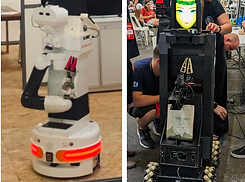
I analyzed eight years of decision-making and collaboration within the world's largest domestic service robotics competition, examining how leaders, engineers, and stakeholders negotiated the criteria used to evaluate innovation.
Insight
Innovation is shaped as much by organizational decision-making as by technology itself. While stakeholders valued ambitious, real-world innovations, ideas perceived as too difficult or resource-intensive were often excluded. Feasibility ultimately played a critical role in determining which innovations advanced.
Implication
For innovation leaders, the greatest constraint on innovation may not be technology itself, but the systems used to evaluate it. By examining which ideas are routinely excluded because of perceived feasibility constraints, organizations can identify overlooked opportunities and design governance, incentives, and resources that support more transformative innovation.
Read My Research
Hauser, E., & Xu, Y., Shorey, S., Menhart, S. (2026). Negotiating the real worlds of domestic service robotics. In Proceedings of the 2026 CHI conference on Human Factors in Computing Systems (CHI’ 26). April 13-17, 2026, Barcelona, Spain.